Capacity Building
Facilitation, teaching & training
For more than fifteen years, I have designed and led learning processes for people doing consequential work — professionals navigating sustainability transitions, graduate students shaping their research careers, and multi-stakeholder groups working across disciplines and sectors to address shared problems.
Whether in a seminar room, a two-day intensive, or an online workshop spanning three continents, the goal is the same: create conditions in which people can think more clearly, collaborate more honestly, and leave better equipped for the work ahead.
Approach
Learning is not a passive process, and change work is not a comfortable one. My facilitation and teaching practice reflects both of these realities. I draw on project- and problem-based learning, futures thinking, and transdisciplinary research methods to design experiences that connect participants' existing knowledge to new challenges and contexts. I pay close attention to group dynamics and psychological safety — not as secondary considerations, but as central conditions for genuine learning to happen.
The thread that runs across all of this work is a commitment to making theory actionable. Participants leave with tools, frameworks, and practices they can apply — not just ideas they have encountered.
Please tell Michael that his response to my thoughts today was 10/10. Spot on to make me feel welcomed again.
Ocean Leadership program participant, UiT — 2024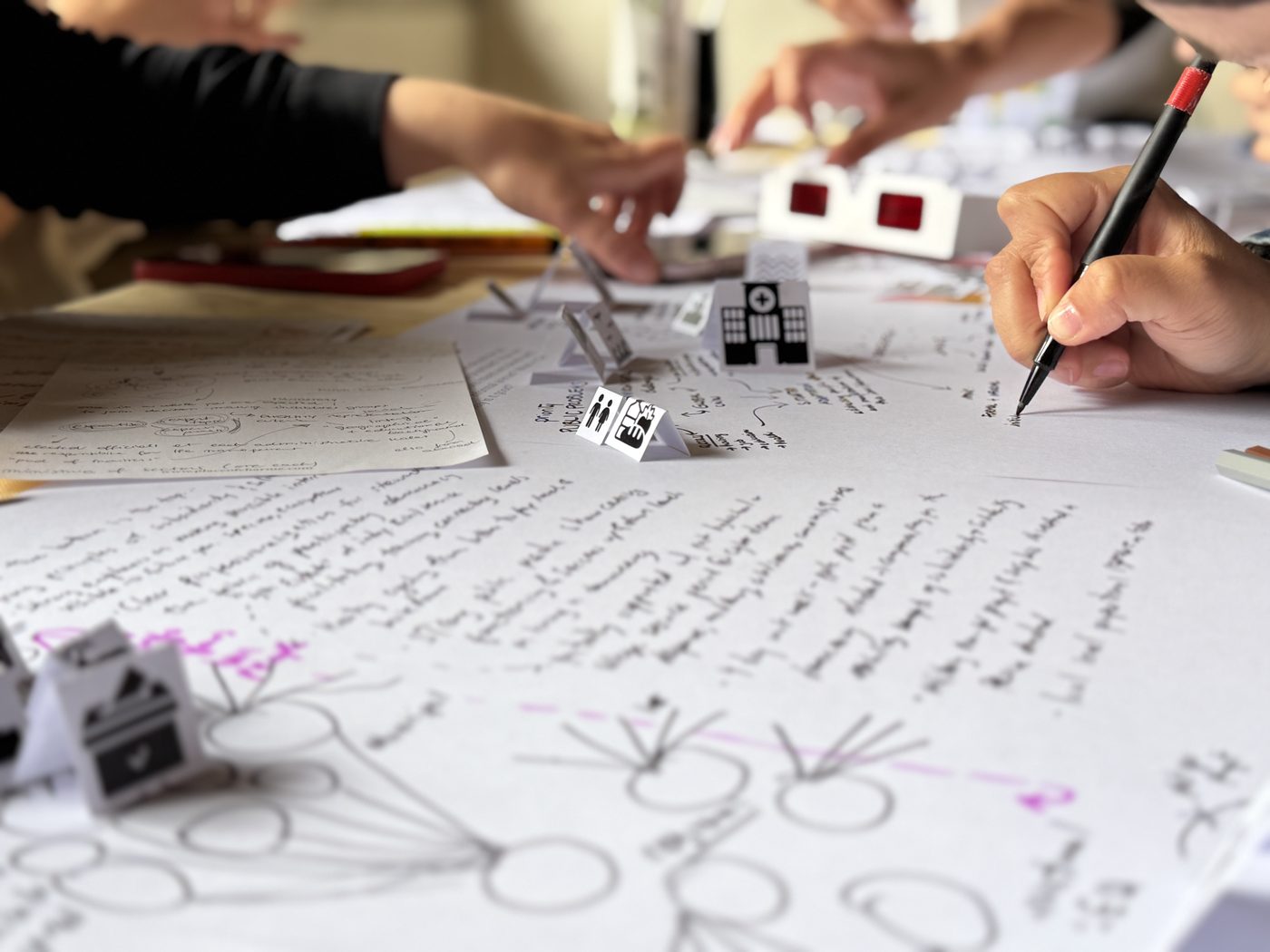
Siena, Italy · Photo © Michael J. Bernstein
Practice areas
Professional programs in sustainability & leadership
Designing and teaching in programs for working professionals who lead change across sectors — from ocean industries and government to finance, research, and civil society. This work involves developing curriculum modules, facilitating intensive residential weeks, supervising applied master's projects, and creating psychologically safe spaces for participants who are grappling with challenging material while continuing to lead in their organizations.
Intensive short courses & winter/summer schools
Designing and running concentrated learning experiences — typically one to two weeks — for international graduate students and early-career professionals. These programs bring together participants from different disciplines and countries to work on shared problems. Curriculum design, facilitation, and participant experience are tightly integrated; there is no separation between the learning environment and the learning content.
Stakeholder workshops & participatory facilitation
Convening people across organizational and disciplinary boundaries to generate new knowledge, develop shared understanding, or move toward collective action. Workshop design for this kind of work is not neutral: it requires thoughtful participant selection, activities calibrated to the research or policy question at hand, and facilitation that creates space for honest conversation — including on sensitive or contested topics — without losing focus on the task.
Research mentorship & supervision
Supporting junior and mid-career researchers to develop the conceptual, methodological, and professional capabilities needed for meaningful, high-quality work. This includes supervision of master's theses and PhD students in externally funded research projects, peer mentoring programs, and ongoing one-on-one coaching — always with attention to both the content of the work and the process of becoming a researcher or practitioner capable of advancing it.
Scale of the work
Across nearly fifteen years, this work has reached participants from dozens of countries and organizations — research universities, European Commission programs, national science funders, government agencies, ocean industries, environmental NGOs, and multi-national companies. The settings have ranged from online seminar rooms to in-person intensives in Arizona, Washington, Norway, Austria, and Japan.
Selected teaching & training record
- 2022–present Ocean Leadership for Sustainability — UiT The Arctic University of Norway. Associate faculty (20% appointment). Modules on sustainability governance, responsible innovation, research skills, and strategic foresight. Four courses across two annual intensive cohorts. Norwegian College of Fishery Science
- 2020 Science Outside the Lab — School for the Future of Innovation in Society, Arizona State University. Ten-day science and technology policy immersion program for STEM PhD students, designed and taught online. HSD 505
- 2019 RRI Training Workshop — EuroNanoMed ERA-Net, Bratislava. Co-organized and facilitated a pilot action to build responsible research and innovation capacity among European nanomedical research funders.
- 2019 Science, Citizens, and Society Workshop — Research Council of Norway, Oslo. Co-organized and led facilitation for a session building RRI and SDG-aligned research capacity among national funder staff.
- 2016 Responsible Research and Innovation — School for the Future of Innovation in Society, Arizona State University. Graduate seminar developed and taught from scratch; focused on science, technology, and social context. HSD 540
- 2014–2018 Winter Schools on Science, Technology & Society — Center for Nanotechnology in Society / NNCI, Arizona State University. Annual five-day intensive for international doctoral students. Lead organizer and lecturer, five editions.
- 2013 Global Classroom on Urban Sustainability — Arizona State University & Leuphana University of Lüneburg. Hybrid trans-Atlantic course for undergraduate students. Designed and taught modules on teamwork, project management, and sustainability research; supervised student group projects.
Open to connecting about workshop design, facilitation, and collaboration.